Português
 English
 Español
 Français
 Deutsch
 Italiano
 日本語
 العربية
 中文
Ask ten people in the travel trade to explain the difference between a DMC, a tour operator and a travel agency, and you will get ten slightly different answers. The labels overlap, many companies wear more than one hat, and in Brazil the confusion goes all the way to the law, which uses a single legal category for all three. Yet the distinction matters every time you plan a program: it decides who designs it, who contracts the hotels, who is standing in the arrivals hall at 6 a.m. and who answers when something goes wrong at night. This guide untangles the three roles, shows where they overlap and helps you decide which one you actually need for a trip to Brazil.
In short: a travel agency sells travel to the end traveler, a tour operator builds and distributes travel packages, often across many destinations, and a DMC (destination management company) designs, contracts and operates programs on the ground in one destination. In an inbound program to Brazil, the three usually work as a chain: the traveler buys from an agency or operator abroad, which relies on a DMC in Brazil to run everything locally. For groups, incentives, events and complex luxury trips, planners often go to the DMC directly.
Three roles, three jobs
The cleanest way to separate the three is by their core job: the travel agency is closest to the traveler, the tour operator sits in the middle and builds products, and the DMC is closest to the destination, with people and suppliers on the ground.
Think of an inbound trip to Brazil as a supply chain. At one end is the traveler in New York, London or Paris. At the other end are the hotels, guides, drivers, restaurants and venues in Rio, São Paulo or the Amazon. Each of the three players occupies a different stretch of that chain, and each brings a different kind of value: relationship, product or operation. The matrix below shows the typical split of tasks.
Notice the last row. The travel agency and the tour operator own the client relationship, while the DMC usually works behind their brand. That is not a weakness of the model; it is the point of it. A good DMC makes its partners look excellent to their clients and never competes with them for those clients.
What a travel agency does

Photo: Wilson Santos Marques / Shutterstock.com
A travel agency, or travel advisor, sells travel to the end traveler: it listens to what the client wants, recommends options, books flights, hotels and experiences, and stays as the client's point of contact before and after the trip.
Agencies range from large retail chains to independent luxury advisors with a small, loyal clientele. Their value is in knowing the traveler: preferences, budget, past trips, the anniversary that needs a special touch. For straightforward trips, an agency books directly with airlines and hotels. For a complex or high-value trip to a destination like Brazil, a good advisor will usually work with a tour operator or directly with a DMC, because nobody can maintain deep supplier knowledge in every destination in the world.
What a tour operator does
A tour operator designs and assembles travel products, from fixed packages to tailor-made itineraries, and distributes them to the market, either through travel agencies or directly to travelers. Most tour operators cover many destinations, so they rely on local partners to execute on the ground.
A tour operator in the United States or Europe might sell Brazil next to Peru, Argentina and Costa Rica. It negotiates rates, builds the product, prices it, markets it and carries the commercial relationship with agencies or travelers. What it rarely has is a team in every destination it sells. For Brazil, that gap is exactly where the DMC comes in: the operator designs and sells, the DMC contracts locally and runs the program.
What a DMC does in Brazil
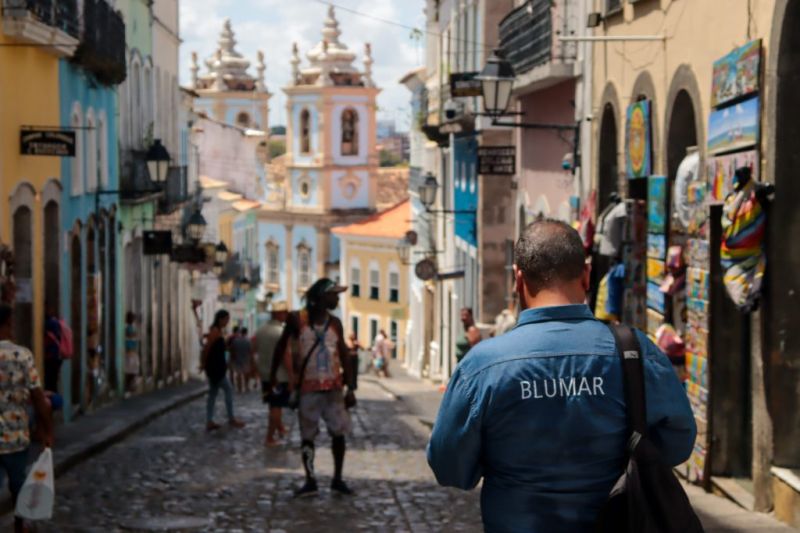
Photo: Guilherme Ferreira / Blumar DMC
A DMC is a locally based specialist that designs, contracts and operates travel programs in one destination: it negotiates with hotels and venues, manages transport, guides and logistics, creates experiences that cannot be booked online and stays with the group on the ground, with a 24/7 response line.
In the Brazilian trade, DMCs are also called inbound or receptive operators. A full-service DMC covers a lot of ground: program design and costing, hotel contracting, ground transportation, guides and hosts, venues and events, curated experiences, permits, supplier vetting, on-site management and a final report. Its clients are usually businesses: tour operators, travel agencies, incentive houses, meeting planners and corporate travel departments. For the full picture, read our complete guide to choosing a DMC in Brazil.
Why the roles overlap, and what Brazilian law says
The roles overlap because many companies combine them: agencies build their own packages, tour operators open local offices and DMCs sell to more than one type of client. In Brazil, the law does not even separate them: travel agencies, tour operators and DMCs all fall under a single legal category, "agência de turismo".
Brazil's General Tourism Law (Law 11,771/2008, updated in 2024 by Law 14,978) defines a tourism agency as a company that earns its income by intermediating tourism services between suppliers and consumers, or by providing those services directly, and its scope includes planning, organizing, contracting and operating them. In practice, "operadora", "receptivo" and "DMC" are market terms, not separate legal types. What the law does require is that tourism service providers register with Cadastur, the Ministry of Tourism's official registry. That is why asking a Brazilian partner for its Cadastur registration is a useful, objective check, whatever it calls itself.
The practical lesson is simple: do not judge a company by the label on its website. Judge it by what it actually does for your program. Who designs it? Who contracts the suppliers? Who is on the ground? Who answers at night? Those answers tell you which role the company really plays.
A day in a group program: who handles what
In a well-run inbound program, your company keeps the client relationship and approves decisions, while the DMC handles everything that happens on the ground, from the airport arrival at dawn to a lost passport in the middle of the night.
The difference between the roles becomes concrete when you follow a single day. Here is what that looks like for an incentive group in Rio de Janeiro.
Notice that the client only needed to call one company the whole day, and that company only needed to call one partner in Brazil. That is the model working as designed: clear roles, one line of communication and nobody improvising.
Which one should you work with?
It depends on what you are planning and who you are. A traveler planning a personal trip should talk to a travel agency or advisor. A company selling Brazil packages to its own clients needs a tour operator backed by a DMC, or is itself the operator. A planner organizing a group, incentive, event or complex luxury trip usually gets the best result by going to a DMC directly.
For the planner in that third case, the next step is choosing the right DMC. Our guide on how to choose a DMC in Brazil: 12 questions to ask before you sign turns that decision into a checklist.
How the three work together on a Brazil program
On most inbound programs, the three roles are links in the same chain rather than competitors: the agency or operator owns the client and the product, and the DMC turns that product into a real, safe and memorable experience in Brazil.
- Incentive house in the United States plus a DMC in Brazil. The incentive house wins the account, designs the concept with the client and manages the participants. The DMC contracts hotels and venues in Rio, builds the experiences and runs the operation.
- European tour operator plus a DMC. The operator sells a Brazil circuit through its agency network. The DMC handles every service in Brazil and supports the operator's agents with product knowledge.
- Luxury travel advisor plus a DMC. For a complex private journey through Rio, the Amazon and the Pantanal, the advisor keeps the client and works with a DMC to design and operate a seamless itinerary.
- Corporate planner plus a DMC, directly. For a conference or a launch event in São Paulo, the planner often contracts the DMC directly, with no intermediary in between.
Common misconceptions
The most common misconceptions are that a DMC is always more expensive, that DMCs only handle large groups and that a travel agency can run a complex Brazil program without local partners.
- "A DMC adds cost." In practice, a DMC's local contracts and volume often offset its margin, and the cost of mistakes avoided is rarely counted. Compare total program costs, not the presence of an extra name in the chain.
- "DMCs only work with big groups." Many DMCs also design and operate private luxury journeys for couples, families and small groups.
- "An agency can do it all from abroad." For simple trips, yes. For multi-city programs, events or remote destinations in Brazil, someone has to contract and operate locally, and that someone is a DMC, whether the client sees it or not.
- "Operator and DMC are the same thing." They can be the same company, but they are different jobs. One builds and sells the product; the other delivers it on the ground.
Where Blumar fits
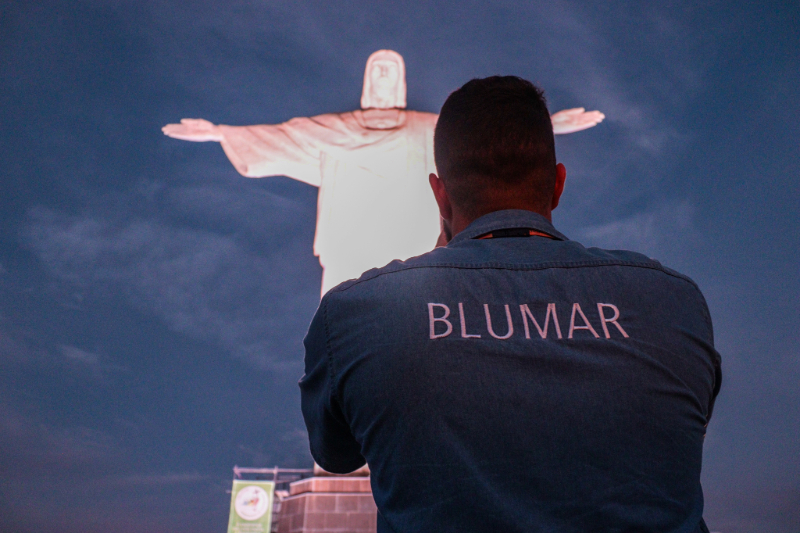
Photo: Guilherme Ferreira / Blumar DMC
Blumar is a DMC: Brazil's largest inbound DMC, headquartered in Rio de Janeiro and operating programs nationwide for tour operators, travel agencies, incentive houses and meeting planners. We work business to business and operate behind our partners' brands.
For more than 40 years, our role has been the last link in the chain: the people who contract the hotels, design the experiences, meet your clients at the airport and answer the phone at 3 a.m. If you sell or plan travel to Brazil, we would be glad to be that link for your next program. Founded in Rio de Janeiro in 1985, Blumar is a Virtuoso Preferred partner and an associate member of USTOA, and its partnerships include IATA, IGLTA, BLTA (Brazilian Luxury Travel Association), Embratur and Visit Rio.
Posts you might also be interested in:
- How to Choose a DMC in Brazil: 12 Questions to Ask
- Blumar DMC at TTG Travel Experience 2026: Brazil at the Heart of Italy's Global Tourism Marketplace
- New Year’s Eve in Rio de Janeiro with Blumar DMC
- Destination Management Company Brazil: Why Blumar DMC is the Leading Choice
- What Is the Best DMC in South America? How to Choose One in 2026
FAQ - DMC vs Tour Operator vs Travel Agency in Brazil
Photo: Catarina Belova / Shutterstock.com
What is the difference between a DMC and a tour operator?
A tour operator builds and distributes travel packages, often for many destinations, while a DMC specializes in one destination and designs, contracts and operates programs on the ground. Many tour operators rely on a DMC in Brazil to deliver what they sell.
What is the difference between a DMC and a travel agency?
A travel agency sells travel to the end traveler and manages the client relationship, while a DMC works mostly business to business, operating programs on the ground in its destination. The agency is closest to the traveler; the DMC is closest to the destination.
What is a receptive operator?
A receptive or inbound operator is a company that receives and operates travelers arriving in its country. In Brazil, the term is widely used for DMCs, although a full-service DMC usually goes beyond transfers and tours to design, contract and manage complete programs.
Is a DMC the same as an inbound tour operator?
The terms overlap and are often used interchangeably. A full-service DMC typically adds program design, supplier contracting, events and on-site management to the classic inbound services. What matters is what the company actually does, not the label.
Does Brazilian law distinguish DMCs, tour operators and travel agencies?
No. Under Brazil's General Tourism Law, all three fall under the legal category of "agência de turismo", whose scope includes intermediating, planning, organizing and operating tourism services. Tourism service providers must register with Cadastur, the Ministry of Tourism's official registry.
Should I book directly with a DMC or through a travel agency?
For a personal trip, a travel agency or advisor is usually the right partner. For groups, incentives, events and complex luxury programs, planners often work with a DMC directly or through their usual operator. Many DMCs, including Blumar, work mainly with travel businesses rather than individual travelers.
Is working with a DMC more expensive?
Not necessarily. A DMC's local contracts and volume often offset its margin, and it prevents costly mistakes that are hard to price in advance. Always compare total program costs with clear inclusions.
Can a company be a tour operator and a DMC at the same time?
Yes. Some companies sell outbound packages and also operate inbound programs in their own country, while others combine agency, operator and DMC roles in one group. In that case, ask which team handles your program and how.
Who is responsible if something goes wrong on the ground?
Operationally, the DMC is the one that acts on the ground, through its 24/7 line and local team. Commercial and contractual responsibility depends on the agreements between the parties, so make sure your contract with the DMC spells out responsibilities, insurance and incident procedures.
Do DMCs work with individual travelers?
Most DMCs work business to business, with tour operators, agencies, incentive houses and planners. Some also offer private luxury journeys, often through a travel advisor who keeps the relationship with the traveler.